Showing posts with label gardening. Show all posts

Thursday, September 24, 2020

Happier Dahlias

I have grown dahlias - not very well - for years.  Inspired by a huge bouquet in my friend Ellen's kitchen, I was thrilled when she told me how easy they are to grow...ha. For her.  She has deep rich soil and endless patience.

My first attempts came roaring up and keeled over, the stems covered with buds broken off.  I felt reproached. And responsible.  So I staked... and  I got a few flowers.  

Ellen told me her dahlias get bigger every year.  I left them in the ground over the winter, looking forward to armfuls of flowers the next year.   Bad idea number two.  We don't freeze, but we have sticky clay soil, and the next spring there was not one dahlia left.  Well, one - the indefatigable Thomas Edison, photos in prior posts.  He is the one thing that kept me from giving up, and every time I see those purple flowers waving above the foliage I feel better.  About everything.

The next year I tried digging them all up in winter ...they were already mush. 
I cried.  Note to self: dig before the rains come.

The following year I dug them in fall, before the rains came.  Laid them carefully wrapped in newspapers in wooden crates in the garage...
Better.  But lots died in storage, and lots didn't sprout in spring. 

I have tried staking.  I have pinched - apparently not enough, for the few dahlias I haven't managed to kill (Thomas and one other nameless hot pink) are taller than I can reach.  And I'm tall.  

So when my friend Meher and I had the chance to visit The Happy Dahlia Farm in Petaluma I was - you guessed it - happy.

It's called the Happy Dahlia Farm for good reason.  Long rows of gorgeousness in a rainbow of shapes and colors greets you. I was stunned.   


There are so many shapes!   Cactus, pompon, dinnerplate.  Waterlily, orchid, peony.  The smaller the flower the more the plant produces.   I confess a soft spot for dinnerplates, but the 4 to 6 inch look best in a vase.  And play well with others. And don't break the stems with the weight of their heads.  
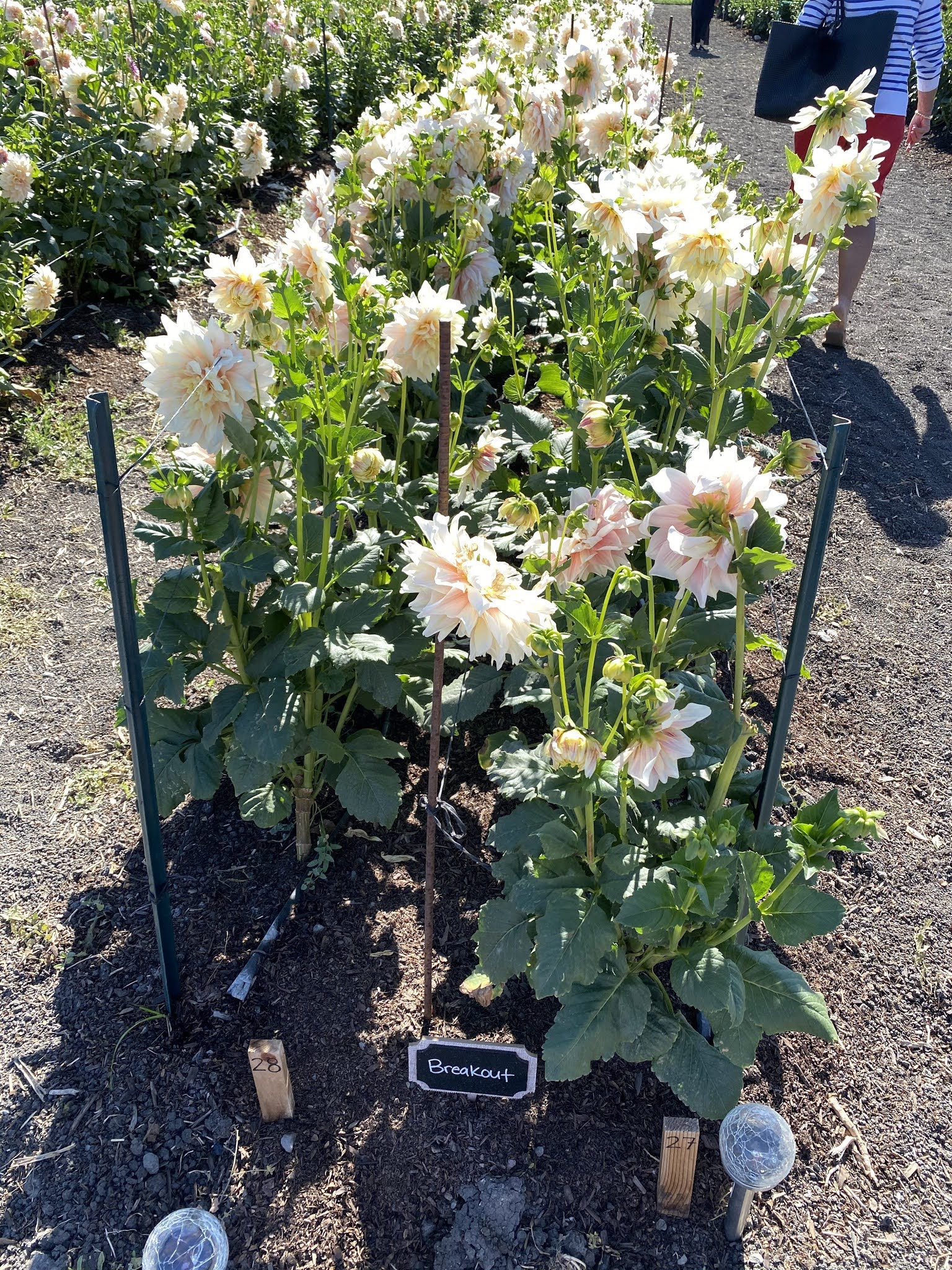

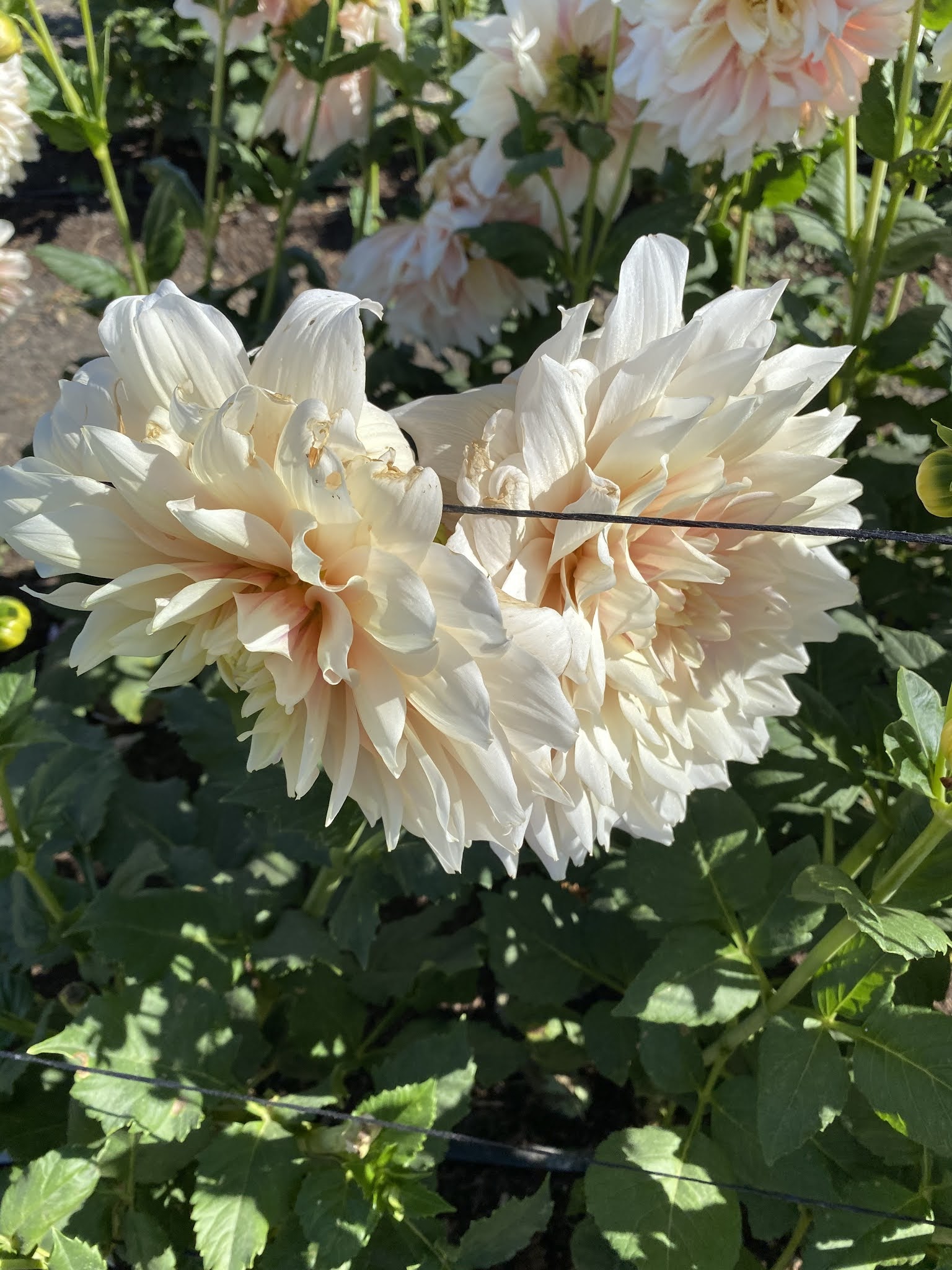
I fell in love with this creamy blowsy dahlia, only to learn she is one of the most difficult.  Figures.  I may still try, but I won't get my hopes up.

At the Happy Dahlia Farm they plant their dahlias 12 inches apart in the row, in double rows with the rows 14 inches apart.  They are supported by each other, and by wires about 2 feet off the ground.  None of the ugly staking I've been living with.  And they have left comfortable aisles between the double rows.  For walking, for cutting.  For dead heading.  For admiring.  For daydreaming.


Half open...


Or in full glory. Every time I turned there was another stunner.  I fell in love with this combination of colors.  I'd like to upholster a couch in these colors.  Or maybe paint a tiny bathroom. So happy.


You can bring a basket and have a social distance picnic.  You can stay as long as you'd like.  You can buy plants and cut flowers.  They sell a few tubers, but plants are a surer thing.  They have a newsletter with advice and events.  They are happy people, these dahlia lovers, and will answer endless questions.   

You cannot, however. cut your own.  It looks perfect because people who know what they're doing tend the dahlias.  If they turned us loose - I shudder to think.  

 You can, however, take all the photos you want, and come home with dreams and aspirations.  Thanks to all their wise advice, humor and kindness I know what I've done wrong, what to let go because gardening is never perfect and nature bats last.  And what to try next year.  Can't wait.

Saturday, August 29, 2020

A Cutting Garden To Save My Sanity

 Before the pandemic, before the lockdown, inspired by my friend Jane and her fabulous cutting garden in East Hampton, I planted a modest cutting garden. At the very bottom of our garden, where there used to be a lawn.  With inadequate drip irrigation...there was a lot of cursing and hand watering at first.  

Some things from seed, most from 4 inch pots.

Some left over from last year (the Thomas Edison dahlias), some gifted by friends.

Tall blue salvia uliginosa, light and airy Nepeta six hills giant, a stiff mystery plant from Portugal with hairy lavender flowers, beginning to go to seed.

Fragrant blue sweet peas planted last fall climbed to the top of their trellis and spilled over.  I've been cutting long branches to try to get them back under control.  They have territorial ambitions.

Huge heads of mid pink scabiosa.  I should have cut this back by half when it was only two feet tall.  It's now over six feet and a constant battle to keep it upright.  And to keep it from going to seed.  

I'm not a fan of daisies but these Shasta daisies may change my mind...they don't need staking and they are cheerful.  Even when I am emphatically not.

And the fabulous Thomas Edison dahlias.  Planted in gopher cages, left to winter over in our sticky clay. They are the only dahlias to return year after year.  

Laid out on the outdoor dining table, ready to arrange.  I start with the filler, the smaller plants that will spill over the vase.  Their stems hold the flowers I want more upright... 

...like the pincushion flower (scabiosa is such an ugly word, sounds like a skin disease) and the daisies.  And that lovely blue salvia.

There were enough flowers for two arrangements. Well, almost.  Another trip down the long staircase to cut more sweet peas. 
Dahlias and other large flowers go in last, then into a dark cool room for a few hours.  Then in places where I can see them - rooms where I spend time, pass by often. Maybe something small in the bedroom, but I want to see them, to enjoy them.

So what have I learned?

First, the descriptions on the plants in the nursery (fabulous cut flower! Trouble free! Blooms all summer!) are often written by someone who either has never grown a thing, doesn't own a pair of shears, has never had a flower arrangement last for more than one day, or is on drugs.  Or is paid to exaggerate.  

Those plants that emphatically do not make good cut flowers? Dug up and given away.  So the second lesson?  Be ruthless.

Next: If you're growing it from seed it will likely set seed and expire - here, as the summer heats up.  In your garden, perhaps as fall approaches.  But in the heat of our long summers so many beautiful things - huge blue scabiosa from Annie's Annuals, fragrant sweet peas in rich burgundy, mallows and hollyhocks - all gone to seed.  And yes, I was diligent about dead heading.  It's been over a hundred here for more than a week.  If I could go to seed I would...

Shasta daisies are on hiatus.  Cosmos have mildewed and quit.  Coreopsis soldiers on, but I am not in the mood for school bus yellow flowers.  Not in the heat; not after months of them.

Roses are still going but they do not last nearly as long in a vase as the dahlias.  

Salvias shed.  Inside, it looks like an invasion of blue bugs under the arrangement.  I sweep the spent flowers into the sink a few times a day, and keep food out of their range.  Blue flowers and breadcrumbs? No.

I've learned a lot about cutting and conditioning too.

Leaves get stripped, especially those below the water line.   Stems re-cut and quickly dipped in Quick Dip,  a flower conditioner, then into warm water and placed in a cool dark spot for conditioning.  The laundry room if the dryer isn't going.  The guest closet. A dark bathroom. The wine cellar if my husband isn't looking.

What do you grow for cutting? What's blooming in your garden?  What makes you happy?


Thursday, April 30, 2015

May To Do In The Garden

Once again, thanks to those lovely and oh-so-knowledgeable folks at Sloat, here is what needs doing in the garden in May.  If you live in Northern Ca.  Of course since we have a miserable drought and scorching hot weather (90 in April...really!) I recommend mixing yourself a gin and tonic.  It won't alleviate the drought, but it makes watching your garden wilt a little easier to take.  Just a little.  


May

  • Plant annuals like petunias, marigolds, begonias, lobelia, salvia and zinnia.
  • Re-seed radishes, carrots and beets.
  • Plant late summer edibles like pumpkins, squash, sunflowers, peppers, basil and melons.
  • Select garden-ready dahlias, perennials, hydrangeas, and hanging baskets.
  • Fertilize rhododendrons, azaleas and camellias with E.B. Stone Organics Azalea, Camellia & Gardenia Food.
  • Give vegetables a boost with E.B. Stone Organics Tomato and Vegetable Food.
  • Feed containers and hanging baskets with Maxsea All Purpose fertilizer.
  • Plant new containers with E.B. Stone Formula 420 to provide the best moisture holding capacity.
  • Prune spring-flowering shrubs after bloom is past. Prune spring flowering Clematis to control size and shape.
  • Mulch vegetable and flower beds with Sloat Forest Mulch Plus to control weeds and conserve moisture.
  • Freshen up containers and replace spent annuals with colorful 4-inch perennials such as verbena, calibrachoa, coleus, bacopa and ipomoea.
  • Don’t forget mom on Mother’s Day! We have blooming flowers, gift cards, and hanging baskets.
  • Check out our selection of specialty hand tools, gloves and sun protective hats.
  • Release ladybugs and other beneficial insects to help control aphids, mites, whiteflies, and other garden pests.
  • The spittle bugs have returned!  Learn more. >
  • Stake tall perennials such as Dahlias.
  • Use beneficial nematodes to manage grubs in your lawn
  • Deadhead spring bulbs but leave the foliage until it turns yellow.
  • Pinch back late summer and fall perennials to promote better flowering, especially mums and asters.
  • Check your hose fittings for spent washers and leaks. Ensure your hose has a shut off valve or other water conserving feature. Consider a soaker hose to conserve water in your vegetable garden.

Thursday, April 2, 2015

To Do In April

So just in case you have some spare time this weekend - bwaa ha ha - here, courtesy of Sloat Nursery in Danville, CA, is what to do in your garden now.  If you live in California.  In the north.  

If you are still shivering under a blanket of snow, may I recommend a Caribbean vacation?  Or a realtor?

April

  • Prune back herbaceous perennials (example: salvia), to promote plant bushiness.
  • Grow your own food this summer! Now is the time to plant edibles like lettuce, tomatoes, herbs, zucchini and berries. Consider a soaker hose to conserve water in your vegetable garden.
  • Prevent powdery mildew and rust on roses and other plants with Bonide Neem Oil. Already have a powdery mildew problem? Treat with Actinovate or Serenade.
  • Aphids are beginning to appear. Stop them early with Bonide Neem Oil.
  • Tomatoes: choose a large cage — your plants will surely grow larger!
  • Plant a tree, shrub, flower or edible for Earth Day or Arbor Day.
  • Stake perennials like Delphinium, Foxglove, peony, coreopsis, garden phlox, hollyhock, centranthus, and Shasta daisy.
  • Start planting summer annuals like lobelia, begonia, marigolds, cosmos, petunias, snapdragon and alyssum. Use Sure Start fertilizer for new plantings to establish them quickly.
  • Apply a lawn fertilizer such as E.B. Stone Nature’s Green to green up your grass gently.
  • Stock up on a season’s-worth of top quality, plant-specific fertilizers from E.B. Stone.The “Naturals” and “Organics” lines are environmentally friendly.
  • Snails and slugs are hatching in your garden right now. Non-toxic Sluggo can help.
  • Mulch vegetable and flower beds with Sloat Forest Mulch Plus.
  • Release ladybugs, praying mantis, and other beneficial insects to help control aphids, mites, whiteflies, and other garden pests. If you release beneficial insects, please don’t spray for garden pests.
  • Work cover crops into the soil before they seed.
  • Say yes to summer bulbs! Plant gladiolus, dahlias & lilies.  Put stakes in place at the time of planting.
  • Shop for clematis and other spring bloomers.
  • It’s also time to start choosing and planting summer perennials: Penstemon, Salvia, Argyranthemum...

Saturday, February 21, 2015

Do It Now

Here, once again, courtesy of the lovely folks at Sloat Nursery, is your to-do list for the garden.  Except, this year in our gardens everything seems to be happening about a month early!  Roses are leafed out; one at Deanna's is already blooming.  Grape vines have uncurled tight fists of leaves.  Daffodils are, for the most part, over.  The buckeye, always precocious, has thrown a dense green roof over the round gravel patio, and covered the big bathroom window.  When I brush my teeth in the morning it's like being under water, cool and deep green.

Dogwood buds have gone from tight grey pincushions to thick and wavy and yellow, like little flags.  They usually bloom in April; this year I don't think they'll last thru March.  

Of course, if you live in the Frozen East, this list will probably just piss you off.  Get out your snow shovel and get over it.  Or come visit - we'll be on the patio.  In our shirtsleeves.

What To Do In The Garden Now:
• Prepare planting beds for spring. Test your soil for pH, nitrogen, phosphorous and potassium and add the appropriate fertilizer or supplement. We recommend amending your soil with Sloat Loam BuilderSloat Forest Mulch Plus or Sloat Planting Mix. Also, add E.B Stone’s Agricultural Lime or Grow More Maxi-Cal to soil to provide needed calcium for vegetables & fruit and to prevent blossom end rot.

• Plant early blooming plants like peonies, wisteria, lilacs, flowering plum, cherries, and magnolia. You can also plant Mediterranean plants such as leucadendrons, lavender, rosemary. Ceanothus and manzanita are great California Native choices.

• Protect your plants from slugs and snails with Sluggo or Sluggo Plus.

• Now is the time to plant edibles: Potatoes, garlic, onions, rhubarb, and asparagus.

• Finish pruning roses, shrubs and trees. Need a little guidance? Check out a pruning seminar at our stores.

• Prune and cut back perennials & ornamental grasses.

• Stop the weeds! Weeds that begin with winter rains go to seed in March & April. But the clever gardener never lets them get that far. Pull weeds now before they go to seed.

• After pruning, feed roses with E.B. Stone Alfalfa Meal and E.B. Stone Naturals Sul-Po-Magto promote healthy cane growth.

• Prune lavender back to emerging new growth for best spike production this coming summer.

• In addition to preparing your planting beds, use winter aged compost to make room for your new trimmings and clippings.

• It’s time to think about starting seeds. Most seeds are started 6-8 weeks prior to the last frost.

• Add summer flowering gladiolas and dahlias to your garden.

• During the month of February we have the best citrus selection of the year. Stop in!

• Protect citrus from rodents with Repels All Ready to Use.

• Now is a good time to feed and repot houseplants in anticipation of spring growth. Check for insects.

• Deadhead cyclamen to keep them in bloom.

• After pruning, be sure to clean your tools.

• Feed the birds: We carry Wild Delight Gourmet Bird Seed, Songbird Blend, Nut & Berry, Nyjer thistle, and Sunflower Seed. Also we have suet in 6 flavors to attract a variety of birds from woodpeckers to phoebes. Finch Socks with Nyjer are easy to use and popular with the birds!

• Keep up on cleaning winter debris from beds and containers.

• Mulch to prevent fungal diseases, conserve water and reduce weeds..

Saturday, January 24, 2015

What's Blooming Now

Daffodils are almost over, 
Hellebores are in full swing:
Pansies brighten up the pots,  
Foliage is king.  
Summer Snowflake is confused: it's not even spring!
Camellias brighten up the shade,
I wonder what next week will bring?

Monday, January 12, 2015

Sharing Citrus

Wally and Norberto harvested most of the lemons and oranges before the first freeze.  And the limes.  

We live in California, remember, and while all of California is emphatically not like L.A.  (contrary to what some of our East Coast friends think - no bikinis and semi-naked surfers here) it is warm enough in the SF Bay Area to grow citrus.  Just barely.  Near the house.  At the top of the slope.  But not when we have an unexpectedly cold year, or an unexpectedly cold night.  It only takes one.

Of course you remember that cold air is heavier than warm air, and it flows like water.  Downhill. Thank goodness.  Everything in the bottom garden has frozen and turned to slime. 

But the citrus near the house was covered with fruit, like some crazy Christmas decorator had gone nuts.  And when the weather prognosticator predicted temperatures in the twenties (no sympathy from those East Coast and Midwest friends, I know... none expected from people expecting a high today of four degrees) we decided to bring them all in.

We have been feeding our oranges Ultra Bloom food, and they are sweet.  Finally.  After, like, five years of sour citrus we finally found the secret.  Tell your friends.  Well, not if you live in Chicago.   It will just piss them off.
We sent Norberto home with bags of lemons and limes, and oranges for his kids' lunches.  We sent baskets home with Sam and Zoey (after a quick lesson in the easiest way to peel an orange) and left boxes for the Gossip Girls.  We ate oranges every morning. 

We left a big bag of limes on Clark and Ellen's front porch - he is famous for his Clarkaritas.  Fresh lime juice, agave nectar, really good tequilla.  Makes me thirsty just thinking about them.

 And we shared with the Food Bank.

My friend Rushika is a big supporter of the local Food Bank, and in the past we have given them peaches and marmalade, jams and jellies.  So we filled up her car.  
It feels good to share.  And everyone remembers the Food Bank at Holiday time, but now?  Not so much.

Let's change that. 

Tuesday, November 4, 2014

November In The Garden

Okay, once again thanks to Dustin and all the smart folks at Sloat Nursery in Danville (and other places), here is your to-do list for November.  Have fun, and don't forget to shop at Sloat!  

November: What to do in your garden this month

  • Look to plant cyclamen in early November. It’s also a great time to plant ground covers and sweet peas.

  • Think fall & winter color: Violas and pansies are perfect for creating mass color in containers or flowerbeds. Available in a variety of hues, they are a terrific ground cover to plant over bulbs in pots or in the ground.

  • For a hardy alternative, consider planting ornamental cabbage and kale.

  • Prepare planting beds for winter. Clear weeds and rocks. Till soil and add soil amendments.

  • Fall is for planting! Get shrubs, perennials and trees into the ground this month. Winter rains will help develop a strong root system.

  • Select bulbs for spring bloom and winter forcing such as hyacinth, paperwhite & tulips.  Refrigerate hyacinth, crocus and tulips 4 to 6 weeks prior to planting.

  • Apply a lawn fertilizer and pre–emergent to control and prohibit annual bluegrass, crabgrass, and other weeds in your lawn and flower beds. Also, aerate and fertilize the lawn with E.B. Stone Nature’s Green.

  • De-thatch lawn if necessary

  • Top-dress perennial beds, azaleas, camellias, and rhododendrons with Sloat Forest Mulch Plus and feed with 0-10-10 fertilizer monthly until bloom (E.B. Stone Organics).

  • Divide the roots and rhizomes of perennials such as agapanthus, yarrow and iris.

  • Store away and clean any unused pots and containers that can be used as hiding places by overwintering insects, slugs and spiders.

  • Lightly prune Japanese maples while still in leaf. Select and plant maples for fall color.

  • It’s time to fill your bird feeders for winter. You can also try a suet feeder!

  • Clean up dead leaves, deadhead flowering plants- diseased leaves should go in the garbage, the rest can go in the compost pile

  • Mulch with compost or Forest Mulch to amend the soil and keep down weeds

  • Pull weeds before they have a chance to drop seeds.  Apply a pre-emergent after fall rains to stop germinating weeds.  Concern Weed Prevention Plus is a safe product derived from corn gluten.

  • Move perennials and shrubs between now and January-prune back lightly first

  • Continue to bait for snails with Sluggo

  • Strip roses Dec-Jan, prune in Jan-Feb

  • Fertilize cymbidiums with 6-25-25 food

  • Fertilize blue hydrangeas with E.B. Stone True Blue now for bluer blooms

  • Fertilize winter color with a blooming plant food (primrose, cyclamen) such as Maxsea 3-20-20.

  • Continue to fertilize citrus with E.B. Stone Organics Citrus Food or Greenall Citrus and Avocado food.

  • Clean and store tools- rub down with alcohol after each use. Grease with white lithium grease to prevent rust. Store shovels and saws in a bucket of sand with a little oil (5 parts sand-1 part oil)

  • If frost is imminent, be sure to water your garden (if it hasn’t rained recently).

  • Use Bonide All Seasons Oil when roses and fruit trees have lost their leaves


PLANT IT NOW! October & November are truly the most advantageous months of the year to get perennials, trees, vines, shrubs and cool season vegetables into the ground. 

Planting now will allow roots to become well established for much stronger, more vigorous plants come springtime. Fall and winter rains mean nature does the weekly watering for you, plus most gardeners see fewer pest and disease problems in the fall.

Happy Gardening!

Thursday, August 28, 2014

Read. Shop. Plant.

Here - courtesy of Sloat Nursery in Danville - is what to do in the garden this month.  Remember: if you don't shop at the local stores pretty soon you won't have any!  And if you sign up for their newsletter they will send you the info directly.

Read. Shop. Plant.  

September

PLANT

  • Watch for the arrival of all our spring bulbs. Shop early for the best selection.
  • Plan landscaping projects now. Think about walkways and flower/vegetable beds, as well as focal point shrubs and trees. Need guidance? Call Sloat’s Garden Design Department for expert advice.
  • Choose fall blooming pansies and other autumn color.
  • Plant fall vegetables such as kale, collard, spinach, arugula and lettuces.

FERTILIZE

  • Apply lawn fertilizer monthly with Nature’s Green Lawn Food.
  • Aerate compacted soil.
  • Containers, summer annuals and cool season annuals will enjoy monthly feeding at this time of year with Maxsea all-purpose fertilizer.

PRUNE/MAINTAIN

  • Keep the garden clean. Pick up fallen fruit to avoid pests and disease next year. Clean out plant debris. Prepare soil with Loam Builder for fall vegetable beds.
  • Mulch with Greenall Micro Bark to inhibit weeds and conserve moisture.

Sunday, June 15, 2014

Time and Tides In The Garden (with apologies to Andy Goldsworthy)

I used to have lavender on each side of the garage doors.  It looked very French, and it smelled great as you brushed past.  Then it smelled great as you drove by, because it overgrew the door and the incoming tires crushed the branches.  

I finally had to take them out.  It was either that, or park in the street.  There was a brief interregnum with an orangey climbing rose whose middle name was surely mildew, but that, fortunately, did not last long.   Sometimes you have to prune with a shovel. 

Now I have boxwood cones, neat and trim and formal.  In poor soil and with not a lot of water, they seem happy.  And mildew free, at least so far.  I have learned never to say never in gardening.

This morning as I was knocking the cobwebs off the boxwood cones (spiders are one of the plusses - and minuses - of organic gardening, but more about that later) I was thinking about how much my garden has changed in the 12 years we’ve been here.  And it's not just the trees getting taller.  

There are many things that didn’t make the cut (pun intended).  The Myrtle leaf orange trees I thought would look so great flanking the front door, and be so good for flower arrangements were in fact a scale factory, and they weeped.  Refused to hold their branches up.  A tree curling to the ground may look great on the other side of a pond, but right next to the front door it  just looked weird.  And don’t get me started on how much the rats liked those trees…makes me shudder just to think.

Plus I am not the flower arranger I thought I was when I planted them.  I love the first day or so, the surprise of that fresh green on a table, the fragrance that fills the room.  But then having to fill the arrangements with water (when there's almost no place to get the spout of the watering can in, when you also have to find a way to stick your finger in the vase so you don't overfill and ruin your table) - it takes the fun out.  And then there are the dying flowers and, if you're not careful, stinking water...not fun.  

My mom prefers her flowers in the garden.  She has a point.

I agonized before I took the oranges out.  I always agonize - those are living things.  But I have realized that once they’re out, I don’t look back.  Not a twinge.  And that’s making it easier to contemplate taking down a tall skinny curly willow that lists badly and is rubbing the eaves.  

It also made the decision to take out a diseased Quince simpler -  I didn’t want the disease to spread, so out it came, roots and all.  And that has been a gift, for it has opened up a view all the way across the garden, to the old oak in the furthest corner, and that view has made the garden feel both more intimate and more expansive.  I don't know how that's possible either - one of the ineffable mysteries of gardening.

Sometimes the things that look like disasters at the time are really gifts in disguise.  That’s a good thing to remember in the garden.  And it’s a good thing to remember in life.

Thursday, June 5, 2014

Snipe Hunt

When I answered the door, I could see just a few wispy blond curls peeking out from behind my neighbor Deidre’s legs, and the edge of a frilly pink skirt.  And a dusty plastic food container clutched in a tiny hand.

“Snelks!” she said softly as she looked up to her grandmother, tugging on her hand and shaking the container.  A round face peered past Deidre’s knee, and I asked: “Would you like to look for snails in my garden?”  With a solemn look of reproach she disappeared behind Deidre’s legs again.  Apparently I’m not authorized to speak to her.  

Taking her by the hand, Deidre led her into my garden.  I tagged along.  If there’s one thing I have plenty of in my garden, it’s snails.  I mean snelks.   Plus, I have a big soft spot in my heart for shy children (and scared dogs).

Knowing that a shy child is like a lot like a scared dog, I kept my distance, and didn’t look directly at her, just kept up a calm steady conversation.  

“You know, snails like to sleep during the day, in a dark spot that’s nice and damp.  Let’s turn over this log, and we can see if there are any snails underneath.”  We struck out on the first log, but under the second there were two huge snails.  I had to point them out - snails and dead leaves look a lot alike.

With two more snails we headed for the compost pile.  An old rotting doormat provides a mostly mud-free place to stand when emptying the compost.  That’s helpful because we’re usually emptying the compost in the  pouring rain - but that. as Des says, is a whole ‘nother Oprah. 

I pulled back the edge of the doormat, and there were several fat shiny snails.  And some even fatter slugs, but she thought they were disgusting and slimy, and she was not interested.  Plus they don’t rattle together like snails do.  Pity - I thought I had found an organic solution to the mollusk crisis and a way to preserve what’s left of the basil.  Alas, no.

A few more stones overturned, a few more snails rattling around in the plastic, and still I was not allowed to speak directly to her - she didn’t disappear when I did, but I did get the “I’m disappointed in you” look every time.

I have learned with dogs and small children that patience is required.  And I’m getting some.  I have patience with children and dogs, just not with idiots.

After lunch the adults were talking books - grown-up books, and I could see her eyes glaze over (grown up talk can be so boring) so I brought out my copy of The Day The Crayons Quit, a book that should be in every library.  Adult or child.  And I started to read it to Deidre, and show her the pictures.  Making sure, of course, that my shy young friend could see too.

A few moments later there was a soft blond head nestled under my chin, and a pair of serious eyes looking at me.  

“Read!” she commanded.  And read I did.  Putting on all my best crayon voices, and using acting skills I didn’t know I had, I read that book.

“Again!” she commanded.  By now the grown ups were talking about us, and I was afraid they would jinx it, this precious chin-tickling moment.  

After the second reading she climbed down and went off to explore the garden.  Beyond snails.  I watched the frilly pink skirt disappear down the steps, and scratched my itchy chin.  

I will always love that book.  And I will always treasure the memory of that solemn face and those wispy curls.  

Jill’s rules for dealing with children: 

Don’t talk down to them.  They’re young, not stupid.

Don’t try to grab them.  If someone twice your size tried to grab you, you’d freak out too.

Be patient.  This is perhaps the most important.  Hint:  works with more than just children.

Figure out what they want to do - unlike most grown-ups, they will actually tell you.  Then do it.  You’re the adult here, it’s up to you to act like a child.  Don’t expect them to meet you on your level.

Be genuine.  Children can spot a phony a mile away.  (Maybe we should put some children on the Supreme Court?  Or sign them up as congressional staffers?)


Don’t forget to have fun.  That is, after all, the point of childhood.

Tuesday, May 13, 2014

May 2014 Postcard From The Hedge

Okay, so I promised a monthly to-do list for the garden, and here - courtesy of Sloat Nursery (and please shop there - they are smart, helpful and funny!)  is your May to-do list.  Check out their advice, sign up for their newsletter - sign up for Orchard's newsletter too.  

Try something new - tomatoes among the petunias, basil and parsley edging a flower bed.  Sage by the front door (and google the folklore about that).  

Then go out and garden - there's a lot to do, and it's the perfect day for it - it's today.  Doesn't get any better than that.

May
Plant
􏰀 Plant annuals like petunias, marigolds, begonias, lobelia, and coleus. Re-seed radishes, carrots and beets.
􏰀 Plant late summer edibles such as pumpkins, squash, sunflowers and melons. 􏰀 Select garden-ready
blooming perennials.
Fertilize
􏰀 Fertilize rhododendrons, azaleas and camellias with E.B. Stone Organics Azalea, Camellia & Gardenia Food.
􏰀 Give vegetables a boost with E.B. Stone Organics Tomato and Vegetable Food.
􏰀 Use a time-release fertilizer such as Osmocote for your container plants.
Prune/Maintain
􏰀 Prune spring-flowering shrubs after bloom is past.
􏰀 Mulch vegetable and flower beds with Sloat Forest Mulch Plus to control weeds and conserve moisture.
􏰀 Freshen up containers and replace spent annuals with colorful 4-inch perennials such as verbena, calibrachoa, bacopa and ipomoea.
􏰀 Release ladybugs and other beneficial insects to help control aphids, mites, white- flies, and other garden pests.
June
Plant
􏰀 Warm season annuals are here! Plant zinnia, salvias, cosmos, lisianthus and portulaca.
􏰀 Plant herbs for use in the kitchen. Re-seed or transplant salad greens, green beans and kales.
Fertilize
􏰀 Your spring plantings are getting hungry. Feed them with all-purpose fertilizers such as E.B. Stone Organics and Maxsea. 􏰀 Feed your lawn with Nature’s Green Lawn Food.
Prune/Maintain
􏰀 Continue to deadhead roses, shrubs and other flowers with Felco pruners to encourage new blooms; for smaller jobs, such as grooming your container creations, use Fiskars Micro Tip Snips.
􏰀 Mulch shrubs and beds to conserve moisture.Try GreenAll Microbark for its beauty and utility.
􏰀 Make sure vegetables are supported with cages, stakes, or trellises.
􏰀 Check early-bearing fruit trees for heavily laden branches.Thin fruits now to increase their size and prevent branches from breaking. Harvest vegetables as they ripen so plants continue producing.
  

Tuesday, April 8, 2014

April Postcard From The Hedge

There have been years when the impatiens lived thru the winter.  This has not been one of them.

In January my garden was rimed with frost, just like those English gardens in the magazines.  Brilliant! I thought...until the frost crystals quit holding hands and the plants collapsed into slime.  All on a bed of sticky mud.

In February my garden looked like it had been hit by a blow torch, and I seriously considered taking up golf.  Or moving.  

But in March my garden started growing, unencumbered by last year's stalks and stems, and it has never looked better.  And if you know anything about gardeners, you know we always say "You should have been here last week - it was so much better" or "Pity you couldn't come next week when the X is blooming."

Not this year.  This year it's perfect.  The dogwood:
The roses:  Golden Celebration,
 Pat Austin,
 and the understated Sally Holmes.
The usual spring things are blooming.  Apple. 
 Lilac,
fragrant Philadelphus.
Geranium and alyssum are dancing with a stone wall. 
And for you smug know-it-alls, this is what a true species geranium looks like.  Not that pelargonium thing the nurseries call geranium.  And that yellow?  That's Alyssum.  Saxatilis.  Not the white sweetly scented thing you call alyssum.  That's lobularia maritima.  Beautiful by any name.   (But do try to be less smug.  It makes the mea culpas so much easier.)

The vineyard is budding...
You can see a baby cluster of what will be grapes (and wine) just peeking out from under. 

The native iris, the one you can grow under oaks and not water all summer is covered in big flat platters of pale blue.  Some hybridizer got all crazy over these and the new colors are fabulous. Glad someone has the patience.  Not me. 
The  ivy geranium (if you've been paying attention, you're yelling "pelargonium!" and you are so right!) are climbing over the stone balls atop the pool wall.  Later they will spill down the wall, but the big freeze gave them an unanticipated haircut.  Needed but unanticipated. 
 And my favorite iris, Victoria Falls, lights up the garden.  It will re-bloom if you feed it well - I have cut this iris at Christmas.  Of course that was in a winter not as cold as the one just past.
Even the sculpture looks happy.  The Big Talk.  
It's a good day to be in our garden.  If we don't answer the doorbell,  come around.  We're in the back.  Talking.  And enjoying one perfect day in the garden.